John Denver
Full Article
John Denver
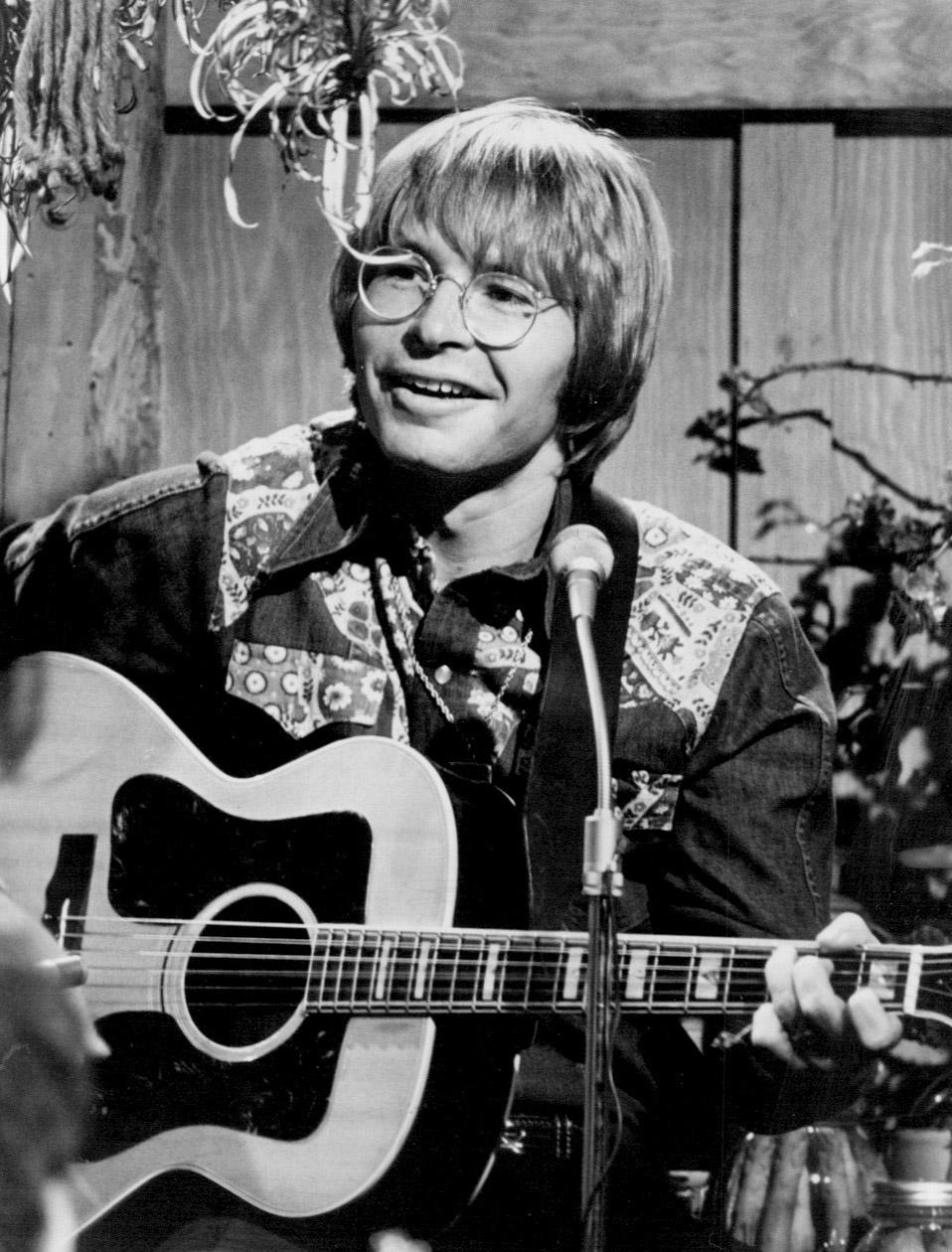
John Denver on the television special An Evening with John Denver, 18 February 1975.
Henry John Deutschendorf, Jr. (31 December 1943 — 12 October 1997), better known as John Denver, was an American singer-songwriter known for his love of Colorado, and for composing and performing “Rocky Mountain High,” one of Colorado’s two state songs. He was one of the most famous and successful musicians of the 1970s, and was known as an advocate for environmentalism and humanitarianism. For most of his life he lived in Aspen, Colorado. He passed away in 1997 at the age of 53 after a plane crash in which he was the pilot. He was the only fatality.
Early Life
Henry John Deutschendor, Jr. was born on December 31, 1943 in Roswell, New Mexico to Erma Louise and Henry John “Dutch” Deutschendorf, Sr. He had a single sibling, a brother named Ronald Deutschendorf.
Henry John Deutschendorf, Sr. was a United States Army Air Force pilot, and as a result the family moved often. From 1951 to 1958, the family lived in Tucson.
While living in Tucson, Henry John, Jr. became a member of the Tucson Arizona Boys Chorus. At age 11, his grandmother gave him an acoustic guitar. He learned to play quickly and developed a strong interest in pursuing music as a career. At the age of 17, when the family was living in Arlington, Texas, Henry John, Jr. ran away from home to California to live with family friends and pursue a music career. His father traveled to California to retrieve him, and Henry John, Jr. returned to Texas where he completed his schooling.
While attending Texas Tech University in Lubbock, Henry John, Jr. joined a folk music group called “The Alpine Trio.” He dropped out of college in 1963 and moved to Los Angeles to once again pursue a career in music. During this time he adopted the stage name John Denver after a colleague advised him that “Henry John Deutscendorf” did not fit on a marquee.
He sang and played in multiple folk music bands for several years until embarking on a solo career in 1969.
Musical Career
John Denver released his first album, Rhymes & Reasons in October 1969 with RCA Records. His song “Leaving on a Jet Plane” (originally written in 1966) was picked up by Peter, Paul and Mary, a very popular folk group. In 1969 their version of the single charted at number one in the United States and number two in the United Kingdom.
Following this, John Denver began traveling across the country on self-financed tours. He performed at small venues such as schools and bars, and for local radio stations. He often secured these gigs because he was the credited songwriter for the very popular “Leaving on a Jet Plane.” Though he often performed for free or for very little money, the tours contributed significantly to John Denver’s growing popularity and bolstered sales of his first albums. He released two more albums in 1970, to limited but growing success.
John Denver’s fourth album, Poems, Prayers & Promises, was released in 1971 and served as his breakthrough. The lead single on the album, “Take Me Home, Country Roads” went to number two on the charts in the US. John Denver’s manager planned a publicity campaign for the track beginning in Denver, Colorado, which was the beginning of John Denver’s increased popularity in the state.
Throughout the 1970s, John Denver was known for his television appearances. He hosted his own variety and music show called The John Denver Show, and won an Emmy for his 1974 live concert special An Evening with John Denver. He appeared on many television dramas as a guest star, was a guest host of The Tonight Show on multiple occasions, and hated the Grammy Awards five times. He was also a frequent guest star on The Muppet Show and collaborated with Jim Henson on two Muppet television specials.
“Rocky Mountain High”
In 1972, John Denver released his sixth album, Rocky Mountain High. This album was his first “Top Ten” album, as it was the fourth best-selling studio album in the country that year. This was in part thanks to the success of the title track, “Rocky Mountain High.”
The song was inspired by John Denver’s experiences in the Colorado Rocky Mountains, primarily a camping trip taken in 1971 with several friends. The lyrics of the song emphasize the natural beauty of Colorado and the emotions he felt while experiencing that beauty in person. The song also laments the “scars upon the land” left by the commercial tourism industry and the construction it brings to the Rocky Mountains.
“Rocky Mountain High” peaked at number nine on the United States Hot 100 in 1973. It has enjoyed enduring popularity in Colorado as a cultural anthem for the state, and is frequently referenced in pop culture featuring or about Colorado.
The song is also popular in marijuana culture for its title (which could be construed as a double-entendre about drug use) and for the phrase “everybody’s high” in the final stanza. John Denver later stated that the title and lyrics are references to the “elation” felt by people who have experienced the Rocky Mountains.
In 1974, in recognition of the impact of this song, John Denver was made the Colorado Poet Laureate.
Later Career and Activism
Towards the end of the 1970s, John Denver’s musical success waned. He continued to release music and tour, but also became more involved in humanitarian efforts. In 1977 he co-founded The Hunger Project, a global non-profit dedicated to eradicating world hunger. The same year President Jimmy Carter appointed him to the President’s Commission on World Hunger. Denver contributed frequently and heavily to various charitable causes, including environmentalism, homelessness, world hunger and sustainable living.
Denver was also involved in state causes. He was a frequent contributor to the Aspen Camp School for the Deaf and the Aspen Valley Hospital, and in 1992, John Denver performed a benefit concert alongside Liza Minnelli and John Oates to fight the passage of Amendment 2 to the Colorado State Constitution.
Death
John Denver was an avid pilot. He was taught to fly by his father in the 1970s, and frequently flew small planes for the rest of his life. On October 12, 1997 he was flying a light two-seater aircraft near Pacific Grove, California, when he lost control of the plane while attempting to switch fuel tanks. This led to a mechanical failure, causing the plane to enter a steep dive and crash into Monterey Bay. Denver was killed on impact. He was the only person in the plane at the time.
Following his death, Colorado Governor Roy Romer ordered all state flags to be flown at half-staff in John Denver’s honor. Funeral services were held in Aurora, Colorado, and Denver’s remains were cremated and the ashes scattered in the Rocky Mountains.
Legacy
John Denver remains a popular and well-regarded musical artist. In 1998, he was posthumously awarded the Lifetime Achievement Award from the World Folk Music Association (WFMA). He is also the namesake of the John Denver Memorial Award which is awarded by the WFMA to artists who embody John Denver’s “spirit” and, like him, endeavor “to make the world a better place.”
In 2007, in recognition of the song’s importance to Colorado culture, the Colorado General Assembly made “Rocky Mountain High” the state’s second official state song, joining “Where the Columbines Grow” which had held the status alone since 1915. Similarly, in 2015 the West Virginia Legislature adopted “Take Me Home, Country roads” as the official state song of West Virginia.
In 2011, John Denver became the first inductee to the Colorado Music Hall of Fame.